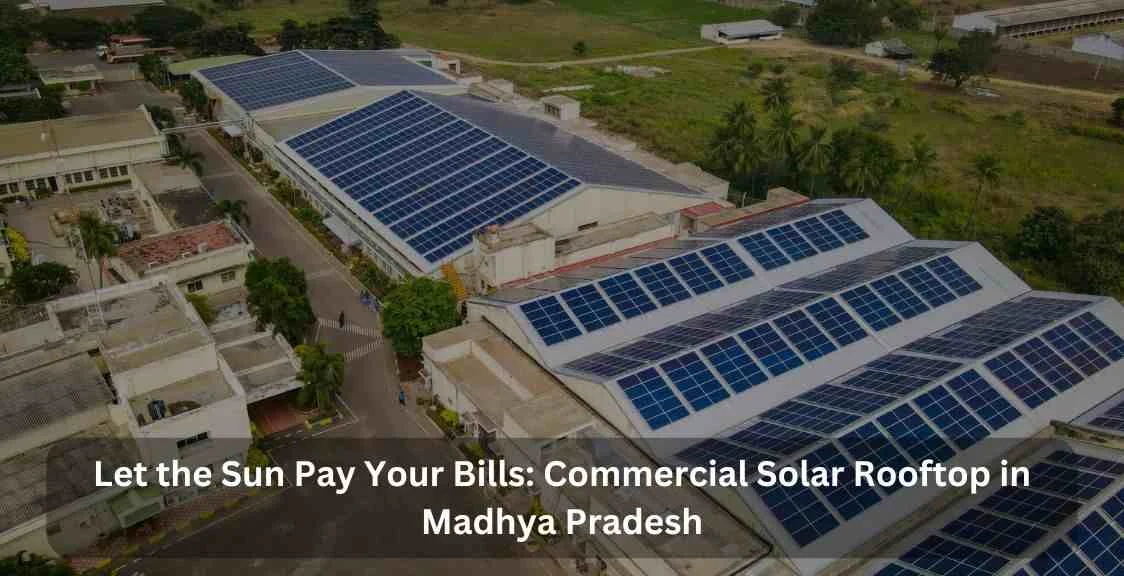
Let the Sun Pay Your Bills: Commercial Solar Rooftop in Madhya Pradesh
Introduction: Turning Overheads into Assets
Conventional electricity is one of the few overheads that rises every single year, eating directly into profit margins. A Commercial Solar Rooftop in Madhya Pradesh flips that script by converting your unused roof into a 25‑year power plant that produces units at a tariff far below the state’s average commercial rate of ₹7‑plus per kilowatt‑hour. Madhya Pradesh (MP) already enjoys almost 320 sunny days annually, and with a forward‑thinking Renewable Energy Policy 2025 that bundles tax breaks, fee waivers, and digitalised approvals, 2025 is the moment when rooftop solar stops being a “green” experiment and becomes a mainstream business strategy.
A Policy Landscape Built for Payback
MP’s 2025 policy refresh offers a 10‑year electricity‑duty exemption, waiver of wheeling and banking charges for behind‑the‑meter systems, and accelerated depreciation of 40 % in the first year—shaving years off the payback clock. Net‑metering rules allow you to feed surplus generation into the grid and receive bill credits that roll over month to month, effectively turning your roof into an energy bank. What’s more, streamlined online applications mean subsidies—where applicable—and net‑metering approvals now close in as little as 30 days.
Counting the Rupees: Two Financing Roads
CAPEX (Own‑Use Model)
You purchase the plant outright and harvest every rupee of savings and tax benefit. With equipment prices below ₹28/Wp for tier‑1 bifacial modules, typical payback ranges between three and five years. Because the system lifespan exceeds 25 years, free power over the next two decades drives internal rates of return (IRR) well above 18 %.
RESCO or PPA Model
If capital is tight, a RESCO developer funds the plant and signs a power‑purchase agreement (PPA) at a tariff 15–30 % lower than today’s grid cost, escalating by only 3–4 % annually—well below the historical utility hike of 7 %. You save from day one without capex, albeit at a slightly lower lifetime IRR because the developer pockets the tax incentives.
Running both options through a discounted‑cash‑flow lens shows CAPEX overtakes RESCO savings by Year 7, but many firms still prefer PPAs to preserve borrowing power for core operations.
Technical Homework Before You Sign
Roof Strength & Geometry – RCC roofs should handle 10–15 kg/m²; older structures may need reinforcement or a lightweight aluminium mounting system.
Shadow Analysis – Use drone or LiDAR scans to spot vents, parapets, or adjacent buildings that could steal irradiance; a consistent 10 % shadow can add a full year to payback.
Module Selection – Bifacial glass‑glass panels yield 5–7 % more energy on reflective roofs and withstand MP’s extreme summer heat better than traditional back‑sheet designs.
Inverter Topology – String inverters suit arrays up to 250 kW; central inverters or modular skid solutions simplify O&M for larger plants.
Monitoring & SCADA – Real‑time dashboards integrated with your building‑management system help finance teams verify savings and trigger maintenance before lost generation hurts cash flow.
Case Study:
A 400 kW Commercial Solar Rooftop in Madhya Pradesh commissioned in February 2025 a top project offers a real‑world benchmark. Installed cost: ₹1.76 crore. Annual generation: 5.9 lakh kWh. Savings at current tariff: ₹41 lakh/year. Payback: 4.3 years after accelerated depreciation and the electricity‑duty holiday. The plant’s live dashboard shows a 76 % performance ratio through the pre‑monsoon dust season, underscoring the value of quarterly cleaning. Similar textile units have placed repeat orders, proving the model scales.
Looking Ahead: Storage, Green Hydrogen & More
MP’s policy blueprint hints at future incentives for battery storage and pilot green‑hydrogen projects. If your business anticipates peak‑shaving or 24/7 renewable mandates from international customers, design today’s inverter room with spare breakers and cable trays. The incremental cost is negligible compared with retrofitting later, and it positions your facility to bolt on lithium‑ion storage or an electrolyser as those incentives arrive.
Common Myths—Busted
- “Solar is only for IT parks.” False. Manufacturing units with daytime loads see the fastest paybacks because consumption aligns with generation peaks.
- “Monsoon ruins output.” Rainy‑season yield dips only 15‑20 % thanks to diffuse irradiance; annual generation models already account for it.
- “Maintenance is expensive.” O&M averages ₹0.35–₹0.45 per unit generated, covering cleaning, inverter checks, and occasional string repairs—far below diesel‑gen‐set maintenance costs.
- “Subsidies are gone.” Direct capital subsidies apply mainly to residential, but commercial players still capture accelerated depreciation, duty waivers, and GST input credits.
Conclusion: Turn Sunshine into Cash Flow
A Commercial Solar Rooftop in Madhya Pradesh is no longer a corporate vanity project; it is a proven, policy‑backed engine that turns sunlight into liquidity. With 2025’s enhanced duty exemptions, record‑low module prices, and marquee projects already lighting up government and private roofs, the question is no longer if solar makes sense, but how quickly you can deploy it before the next electricity‑tariff hike cuts deeper. Audit your load, vet an MPUVNL‑approved EPC, and let the sun pay your bills for the next quarter‑century. The sooner you raise that first module, the sooner your rooftop graduates from overhead to revenue stream.