Solar for MSMEs and Small Businesses | PickRenew Energy
Solar for MSMEs and Small Businesses: Is It the Right
Move for You?
Micro, small and medium enterprises are the backbone of many local economies. They run
workshops, small factories, processing units, clinics, shops and offices, often on tight
budgets and thin margins. For such businesses, a rise in the electricity bill can be felt
immediately in profits.
Solar energy is often seen as something only large companies can afford. In reality, many
smaller businesses can benefit too, provided the plant is properly sized and the investment
is planned carefully. This guide explains how MSMEs can approach solar with confidence.
1. Why Energy Costs Hit Small Businesses Hard
Large companies can spread energy costs across big operations and negotiate in different
ways. Smaller businesses have less room. When power costs rise, they either absorb the
increase and see their margins shrink, or pass it on to customers and risk losing business.
Either way, controlling energy cost is a direct way to protect profitability.
2. Is Solar Only for Large Companies?
No. Solar plants can be designed at many sizes. A small manufacturing unit, a workshop, a
cold room, a school or a showroom can each have a plant sized to its own load and roof
area. What matters is not the size of the business but how well the plant matches its
daytime energy use.
3. Start With Your Consumption
The best starting point is your own electricity data. Gather your recent bills and note the
units used each month, your tariff category and the hours when your machines and
equipment run. Businesses that work mostly in the daytime are usually well placed to use a
large share of their solar generation on site.
4. Right-Sizing the Plant
A bigger plant is not always a better one, especially for a smaller facility. An oversized plant
may generate more than the business can use, while an undersized one leaves savings
unclaimed. The right size depends on daytime consumption, the usable roof or land area
and future plans such as new machines or added shifts.
A proper site survey and load analysis are particularly valuable for smaller businesses,
because every rupee of investment needs to work hard.
5. Budget and Cash Flow Considerations
For an MSME, the upfront investment is a major decision. It should be weighed against the
savings expected and against other uses of capital in the business. Depending on
circumstances, owners may consider paying upfront, using financing or exploring
service-based arrangements where available.
Each approach has different implications for cash flow, ownership and total savings. It is
wise to compare them with real numbers for your own facility before deciding.
6. Policy Support and Incentives
Various central and state-level schemes, incentives or financing options may be available to
eligible small businesses. These programmes change from time to time, and eligibility
conditions differ. It is best to confirm the current position with your EPC partner, your bank
or your tax advisor, rather than assuming any benefit in advance.
7. Choosing Quality on a Budget
When funds are limited, the lowest quote can be tempting. But a small business is usually
less able to absorb the cost of faults and downtime than a large one. Quality components,
sound installation and proper warranties are therefore especially important, and they are
worth comparing carefully across proposals.
• Check the brands and specifications of panels and inverters.
• Ask what warranties apply and who will honour them.
• Confirm what is included in the price, including approvals.
• Look for a partner with a record of delivering projects of a similar size
8. Roof and Premises
Smaller premises often have limited roof area, and the roof itself may be older or of a lighter
construction. The roof’s strength and condition should be assessed, along with shading from
nearby buildings or equipment. If the premises are rented, the lease term and the landlord’s
permission need to be clarified before investing.
9. Installation With Minimal Disruption
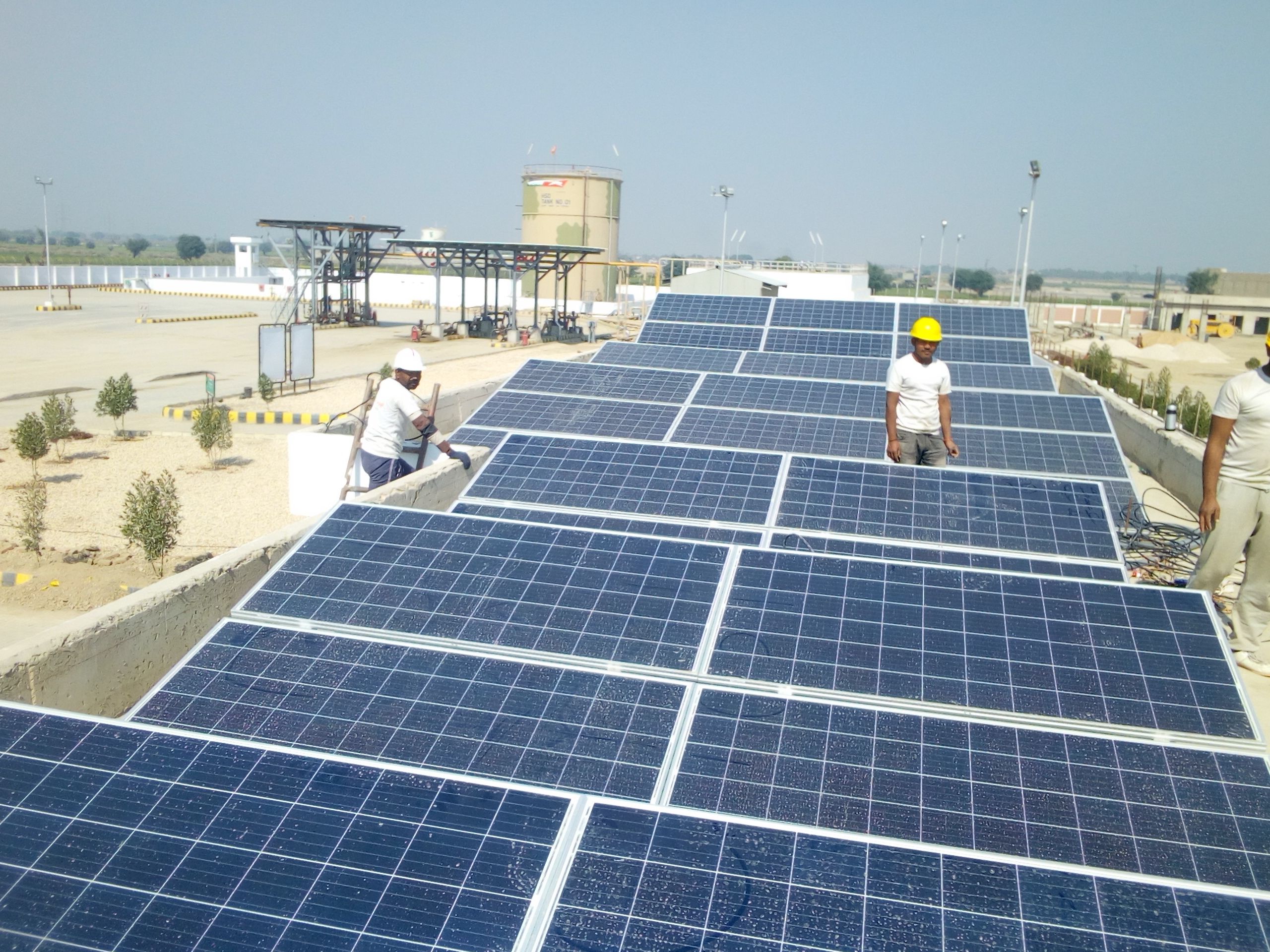
Installation for a small plant is generally quicker and less complex than for a large one, but it
still needs coordination. Work is planned around your operating hours, with most activity on
the roof. Where a short interruption is needed for electrical connection, it is arranged in
advance so that production is affected as little as possible.
10. Maintenance for Businesses Without Technical Staff
Many small businesses do not have dedicated engineers, so support after installation
matters. A good EPC partner offers simple monitoring, regular cleaning and inspection and
a clear point of contact when something needs attention. This allows the owner to focus on
the business, while the plant continues to deliver.
11. Benefits for Small Businesses
• Lower electricity bills that improve margins.
• More predictable costs that make pricing and planning easier.
• Stronger competitiveness from a reduced energy cost within each product or service.
• Better standing with larger buyers who increasingly look at suppliers’ sustainability
efforts.
• A long-lived asset designed to perform for 25 years or more.
12. Mistakes to Avoid
• Choosing a plant size without studying your own load.
• Selecting a partner on price alone.
• Assuming incentives without confirming eligibility.
• Ignoring the roof condition or lease terms.
• Overlooking maintenance and after-sales support.
Questions to Ask Your EPC Partner
• Have you completed projects for businesses of my size?
• How will you decide the right capacity for my load and roof?
• What are my options for funding the investment?
• What approvals are needed, and who will handle them?
• What support will I receive after installation?
Conclusion
Solar is no longer only for large corporations. With a well-sized plant, a sound partner and
careful planning, MSMEs and small businesses can lower their energy costs, protect their
margins and build a stronger foundation for growth. The key is to begin with an honest look
at your own consumption and to choose quality over the cheapest quote.
At PickRenew Energy, we help industrial and commercial clients with end-to-end solar EPC
solutions, from design and installation to approvals and maintenance.
Ready to find out what solar could mean for your facility? Talk to PickRenew Energy:
pickrenewenergy.in